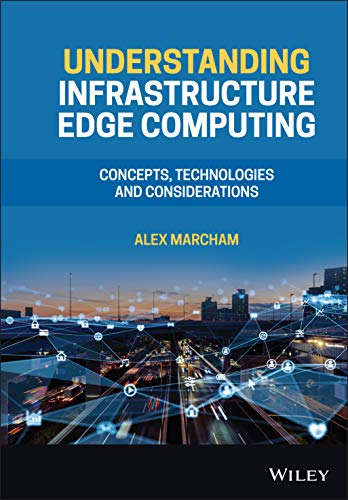
Understanding infrastructure edge computing : concepts, technologies and considerations / Alex Marcham.
Material type: TextPublisher: Hoboken, NJ, USA : Wiley, 2021Description: 331 pages : ill ; 24 CmContent type:
 - text
- unmediated
- volume
- 9781119763239
- 005.758 M.A.U 2021 23
- QA76.583 .M37 2021
| Cover image | Item type | Current library | Home library | Collection | Shelving location | Call number | Materials specified | Vol info | URL | Copy number | Status | Notes | Date due | Barcode | Item holds | Item hold queue priority | Course reserves | |
|---|---|---|---|---|---|---|---|---|---|---|---|---|---|---|---|---|---|---|
 Books
Books
|
Capital Universities Foundation Library (CUFL) School of Computer Sciences (ENU) | 005.758 M.A.U 2021 (Browse shelf(Opens below)) | Available | 1404 |
Browsing Capital Universities Foundation Library (CUFL) shelves,Shelving location: School of Computer Sciences (ENU) Close shelf browser (Hides shelf browser)

|

|

|

|

|

|

|
||
| 005.74 H.J.M 2013 Modern database management / | 005.7565 B.B.O 2017 Oracle database 12c release 2 new features / | 005.7565 G.J.D 2019 Data science from scratch : first principles with Python / | 005.758 M.A.U 2021 Understanding infrastructure edge computing : concepts, technologies and considerations / | 005.7585 L.B.R 2009 Microsoft SQL server 2008 reporting services / | 005.8 A.W.S 2018 SQL Server 2017 administration inside out / | 005.8 M.R.B 2020 Build your own cybersecurity testing lab : low-cost solutions for testing in Virtual and Cloud-based environments / |
Includes bibliographical references and index.
"This book is intended to provide the reader with a thorough understanding of the growth in internet infrastructure since its inception, through to the emerging set of technologies known as infrastructure edge computing which progress this trend to its next generation. Infrastructure edge computing is the term coined by the author (and now accepted by the Linux Foundation and their LF Edge group, as well as much of the industry) for a model of data center and network infrastructure deployment which distributes a large number of physically small data centers around an area to provide users with superior performance than is achievable today, to enable a range of new use cases in an economical fashion. These use cases include 5G (Fifth Generation) mobile cellular networks, city-scale AI (Artificial Intelligence) systems which can help us work and play more effectively by automating many time-consuming tasks, and cyber-physical systems such as self-driving cars, drones and industrial robotics systems to save time, save money and improve safety. To provide the reader with a full understanding of the subject, the book will cover several topics from today?s state of the art to how the infrastructure edge computing model alters that to the key technologies underpinning its deployment and operation, through to the use cases which it will support that are impractical or impossible on current infrastructure. The end result is to provide the reader with a thorough, accessible and accurate understanding of the next generation of internet infrastructure as a whole"-- Provided by publisher.
There are no comments on this title.